
Your Trusted Fertility Clinic In New York, NY
Your Journey. Your Family.
At Sher Fertility Solutions, we understand that each patient is unique. Everything we do is customized to you and your specific needs.
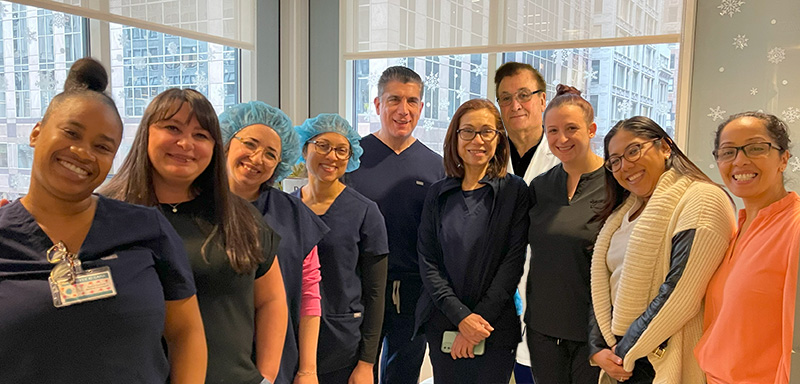
Where Are You On Your Fertility Journey?

I´m just starting out
I need more information

Ready to get started
Book a consultation

I need help
Ask a question
Su clínica de fertilidad de confianza en New York, NY
Tu viaje. Tu familia.
En Sher Fertility Solutions, entendemos que cada paciente es único. Todo lo que hacemos está personalizado para usted y sus necesidades específicas.
Nuestros Servicios
Fertilización In Vitro (IVF)
La Fertilización In Vitro (IVF) es uno de los tratamientos de fertilidad más efectivos. Este proceso implica la combinación de óvulos y espermatozoides en un laboratorio para crear embriones, que luego se transfieren al útero. Más información sobre IVF
Inseminación Intrauterina (IUI)
La Inseminación Intrauterina (IUI) es un procedimiento menos invasivo en el que se colocan espermatozoides directamente en el útero durante la ovulación. Es una opción popular para parejas con problemas leves de fertilidad. Más información sobre IUI
Congelación de Óvulos
La Congelación de Óvulos permite a las mujeres preservar su fertilidad para el futuro. Este procedimiento es ideal para aquellas que desean retrasar la maternidad por razones personales o médicas. Más información sobre Congelación de Óvulos
Reserve una consulta
Si está interesado en tener una consulta sobre tratamiento de fertilidad con uno de nuestros médicos, por favor complete este formulario
Su clínica de fertilidad de confianza en New York, NY





Your Trusted Fertility Clinic in New York, NY
Your Trusted Fertility Clinic in New York, NY
The Best of Dr. Sher on The Egg Whisperer Show

Testimonials

Blog


Our Team

Videos
Our Services

Infertility diagnosis/treatment
The causes of infertility are multiple and are often difficult to define but may include anatomical conditions involving tubal patency and/or function as well as diseases of the testicles and/or or sperm ducts, dysfunctional levels of certain hormones in both men and women, and ovulation difficulties in women.

Recurrent miscarriage diagnosis/treatment

Egg freezing for future fertility
There are many reasons why patients may need to preserve their fertility. For some, it may be a focus on education and career delays and for others it may be due to an illness. Although the decline in reproductive potential that occurs with age cannot be reversed, freezing your eggs at a younger age may allow the eggs to be preserved until you are ready to conceive. While there are no guarantees, using cryopreserved eggs may improve your chances for pregnancy in the future.
Testimonials
Ask Our Doctors
Dear Patients,
I created this forum to welcome any questions you have on the topic of infertility, IVF, conception, testing, evaluation, or any related topics. I do my best to answer all questions in less than 24 hours. I know your question is important and, in many cases, I will answer within just a few hours. Thank you for taking the time to trust me with your concern.
– Geoffrey Sher, MD
My name is Polona, I’m 50 and I’ve done four IVF cycles, all in North Cyprus, two of them when I was 48 and two of them at 50, for the last one I changed clinics. I’m planning to do one more round with my own eggs and need some advise with the stimulation protocol, since all my doctors use only basic protocols. I listened to your webinar IVF stimmulation protocols and was really impressed, but also confussed. Most of the doctors say that you have to add more LH in older women, because they don’t have enough of it and their receptors for LH are damaged. And also most of them use Femara. I know that at my age is almost imposssible to get an euploid embryo,but want to try one more time with optimal protocol. After that, if I fail to get euploids, I want to transfer one of the donor embryos (I had tandem cycle last round).
I have PCOS, but I don’t have many symptoms – I’m skinny ( but have to watch my diet and do a lot of sports), I don’t have high androgens, I think I don’t have insulin resistance, but I don’t ovulate if I don’t take Femara (day 3 to 7) and even Femara sometimes doesn’t help.
My latest bloodwork and AFC (after fourth IVF):
25.8.2023, day 2 (after the last IVF
FSH= 4.4 mIU/L
LH= 4.2 mIU/L )
prolactin= 6.4 microg/L
estradiol= 111.6 pmol/L
AMH= 5.60 ng/mL
AFC at day 4: 13+13=26
My bloodwork and AFC (before starting the fourth IVF):
4.5.2023, day 3:
FSH= 7.0 mIU/L (it was 12.4 in 2021)
LH= 5.8 mIU/L (it was 15.35 in 2021)
prolactin= 14.5 microg/L
estradiol= 90.9 pmol/L ( it was 33.17 in 2021)
AMH= 4.05 ng/mL ( it was 3.99 in 2021)
AFC at day 4: 7+7 =14
22.5.2023, day 21:
progesteron= 30.61 nmol/L (it was 44.77 in 2021)
testosteron= 0.14 nmol/L
I’m taking a lot of supplements for last two years and doing red light theraphy from May 2023.
My stimulation protocols and results were:
Avgust 2021:
– Gonal f 300IU for 9 days (plus Femara for first 5 days),
– adding Cetrotide from day 7
– trigger with Gonapeptyl day 10
22 collected – 7 mature – 3 fertilized – 3 frozen at day 3
After the egg collection I had HSG done and they discovered I had an Y shaped uterus and they operated and I think it is now ok.
November 2021:
the same, only a day more of Gonal f and trigger one day later
15 collected – 9 mature – 7 fertilized – 6 frozen on day 3
They did PGT on all embrios together, but only 5 chromosome FISH (13, 18, 21, X, Y), two came out normal, one was monosomy 18, X0.
I transfered all three (one by one), but didn’t implant.
March 2023:
– Gonal f for 9 days (plus Femara day 1 to 5)
– adding Dabroston pills at day 7 ( instead of Cetrotide)
– trigger with Gonapeptyl at day 13 (I overslept the trigger and did it 8 hours late), they collected 11h after the trigger.
I ovulated before collecting, I think at day 7, I think because I wasn’t taking Certrotide injections, but they said, Dabrostone pills were OK.
7 collected (the big ones ovulated before collection) – 3 mature – 0 by day 3
After that failed cycle I changed the clinic, but wasn’t sure from the start if the stimulation protocol they prescribed would be ok for me (high doses of FSH). I did an estrogen priming, but my doctor didn’t read my mails and he didn’t know I did it. My follicles weren’t growing at all at the beginning (because of estrogen priming, but I didn t know at first that was the cause), I told the nurse about the estrogen priming, but I think she didn’t tell the doctor, so he just kept highering the dose of meds. At trigger day they said that there were a lot of big follicles, but then they collected only four (I still don’t know what happened to the rest, because I left right after the egg retrieval and I still didn’ t get an explanation by mail). Only two were fertilized and only one made it to day 5 to early blastocyte stage, but it was tested chaotic. They did a cytoplasmic transfer on both of them and also fertilized 7 donor eggs with the same donor sperm, but only 3 got to day 5. I still didn’t get an explanation, what was the problem, but anyway, I have three frozen donor embryos there and two frozen donor eggs. I took hGh for 8 weeks before and during the last stimulation. Last stimulation protocol and results:
July 2023, (AFC at day 3 was 10):
Day 1 to 5: Gonal f 375 IU and Femara
Day 6: Gonal f 300 IU, Meriofert 150 IU
Day 7 to 12: Gonal f 350 IU, Meriofert 150 IU
Day 13 and 14: Gonal f 350 IU, Meriofert 300 IU, Cetrotide
Day 15: trigger with Gonapeptyl, half of Ovitrelle and Cetrotide
Day 17: 4 collected – 2 fertillized- one early blastocyst at day 5, tested chaotic
If it is possible, I would be glad to have an online consultation about my case. I’m from Slovenia (Europe).
Thank you for your answer!
Latest Videos
Blog
No Results Found
The page you requested could not be found. Try refining your search, or use the navigation above to locate the post.
Our Team
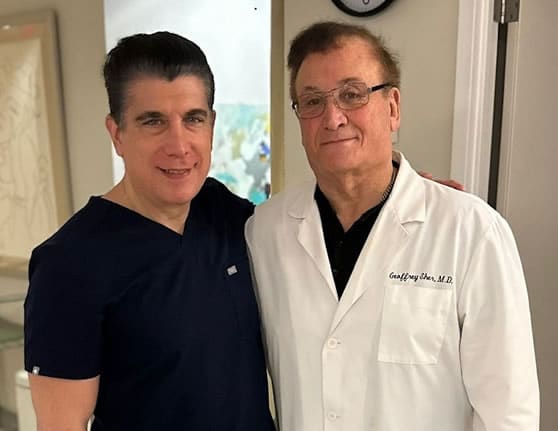
The emphasis we put on innovative, state-of-the-art technology began with our founder, Dr. Geoffrey Sher, one of the pioneers in the field of IVF, who has been influential in the births of more than 17,000 IVF babies. Dr. Sher plays an active role alongside our medical director, Dr. Drew Tortoriello. Together they have over 55 years of clinical and academic experience in the field of Reproductive Medicine.
Together, they were the first to introduce Preimplantation Genetic Testing which vastly increases the chances of IVF success and is now performed worldwide. They also pioneered the testing and treatment of Immunologic Implantation Dysfunction (IID) that frequently leads to “unexplained” infertility, repeated IVF failure, and recurrent miscarriage. We’re able to conduct a variety of other treatments and tests right on site. For example, we offer on-site sperm testing to ensure proper sperm selection techniques are used to create the healthiest possible embryos.
For those women seeking to preserve their fertility, we offer vitrification, a state-of-the-art technology that ensures their eggs will ultimately be thawed successfully.
From the moment you walk into our state-of-the-art New York fertility clinic, you’ll feel the warmth and compassion that will define your experience with us. Drew Tortoriello, MD serves as our Medical Director. He’s an outstanding fertility specialist that you’ll find to be caring, compassionate and personable.
When you receive fertility treatment with us, your doctor will participate with hands-on management of your case throughout your treatment. We’ve gained a reputation of being the place to turn to when all other treatment options have failed, and patients are searching for hope and fresh alternatives.
TL;DR:
- Our doctors are among the best in the world, with over 55 years of combined experience
- Together, they pioneered several tests and treatments that can help where other treatments have failed
- We do many tests right here at the clinic, which means faster results and ensures proper techniques are used
- Your doctor will be with you at every step of your treatment
- Everyone here will get to know you during your treatment so you won’t just feel like a number
- We’re known for being the clinic to go to when all other treatments have failed