Your Trusted Fertility Clinic In New York, NY

Your Journey. Your Family.

At Sher Fertility Solutions, we understand that each patient is unique. Everything we do is customized to you and your specific needs.

Group photo of the Sher Fertility Solutions clinic team

Where Are You On Your Fertility Journey?

I´m just starting out

I need more information

Ready to get started

Book a consultation

I need help

Ask a question

Su clínica de fertilidad de confianza en New York, NY

Tu viaje. Tu familia.

En Sher Fertility Solutions, entendemos que cada paciente es único. Todo lo que hacemos está personalizado para usted y sus necesidades específicas.

Group photo of the Sher Fertility Solutions clinic team

Nuestros Servicios

Fertilización In Vitro (IVF)

La Fertilización In Vitro (IVF) es uno de los tratamientos de fertilidad más efectivos. Este proceso implica la combinación de óvulos y espermatozoides en un laboratorio para crear embriones, que luego se transfieren al útero. Más información sobre IVF

Inseminación Intrauterina (IUI)

La Inseminación Intrauterina (IUI) es un procedimiento menos invasivo en el que se colocan espermatozoides directamente en el útero durante la ovulación. Es una opción popular para parejas con problemas leves de fertilidad. Más información sobre IUI

Congelación de Óvulos

La Congelación de Óvulos permite a las mujeres preservar su fertilidad para el futuro. Este procedimiento es ideal para aquellas que desean retrasar la maternidad por razones personales o médicas. Más información sobre Congelación de Óvulos

Reserve una consulta

Si está interesado en tener una consulta sobre tratamiento de fertilidad con uno de nuestros médicos, por favor complete este formulario

Su clínica de fertilidad de confianza en New York, NY

Five Start Rating

Your Trusted Fertility Clinic in New York, NY

Five Start Rating

Your Trusted Fertility Clinic in New York, NY

The Best of Dr. Sher on The Egg Whisperer Show

Our Services

Infertility diagnosis/treatment

The causes of infertility are multiple and are often difficult to define but may include anatomical conditions involving tubal patency and/or function as well as diseases of the testicles and/or or sperm ducts, dysfunctional levels of certain hormones in both men and women, and ovulation difficulties in women.

Recurrent miscarriage diagnosis/treatment

The time has come to embrace the reality that the term “unexplained” is rarely applicable to 1) infertility of unknown cause, 2) repeated IVF failure, and 3) recurrent pregnancy loss (RPL). More often than not, rather than being “unexplained,” the condition is simply ignored and as such remains “undiagnosed.” All that is needed is to investigate and treat the issue appropriately in order to solve the problem.

Egg freezing for future fertility

There are many reasons why patients may need to preserve their fertility. For some, it may be a focus on education and career delays and for others it may be due to an illness. Although the decline in reproductive potential that occurs with age cannot be reversed, freezing your eggs at a younger age may allow the eggs to be preserved until you are ready to conceive. While there are no guarantees, using cryopreserved eggs may improve your chances for pregnancy in the future.

Testimonials

Ask Our Doctors

Dear Patients,
I created this forum to welcome any questions you have on the topic of infertility, IVF, conception, testing, evaluation, or any related topics. I do my best to answer all questions in less than 24 hours. I know your question is important and, in many cases, I will answer within just a few hours. Thank you for taking the time to trust me with your concern.

– Geoffrey Sher, MD

Name: Erin K

Hello, I was treated with Clomid day 5-9 and I am 36 years old. I failed to get pregnant 5 months and was prescribed this because of pcos. At the ultrasound at 12 days I had 4 mm endometrium and 21 mom follicle. I had a positive ovulating test (lh surge in urine test) two days later. My cycle was longer than usual (40 days compared to 34) and I had my period more than 3.5 weeks after ovulation test was positive. Today I went for baseline scan and doctor suspended Clomid and told me I have a 40mm follicle. What could have happened? Will this 40 mm follicle resolve on its own and what does it mean for this cycle?

Answer:

Clomiphene citrate (Clomid, Serophene) is the most popular agent used for inducing ovulation and in the 1980’s was also the most widely used method for COH in preparation for In Vitro Fertilization (IVF). Clomiphene citrate is a synthetic hormone that deceives the hypothalamus into thinking that the body’s estrogen level is too low. In response, the hypothalamus releases GnRH (gonadotropin-releasing hormone), which in turn prompts the pituitary gland to release an exaggerated amount of FSH (follicle-stimulating hormone). As happens in nature, the increased secretion of FSH stimulates development of the follicles, ultimately resulting in ovulation. The growing follicles secrete estrogen into the bloodstream, thus closing the feedback circle that the hypothalamus initiated in response to the anti-estrogen properties of Clomiphene.

_________________________________________________________

ADDITIONAL INFORMATION:

I am attaching online links to two E-books which I recently  co-authored with  my partner at SFS-NY  (Drew Tortoriello MD)……. for your reading pleasure:

1.From In Vitro Fertilization to Family: A Journey with Sher Fertility Solutions (SFS) “

http://sherfertilitysolutions.com/sher-fertility-solutions-ebook.pdf

  1. “Recurrent Pregnancy Loss and Unexplained IVF Failure: The Immunologic Link

https://drive.google.com/file/d/1iYKz-EkAjMqwMa1ZcufIloRdxnAfDH8L/view

If you are interested in having an online consultation with me, please contact my assistant, Patti Converse at 702-533-2691 or email her at concierge@sherivf.com

………………………………………………………………..


Administration of Clomiphene citrate enhances the normal cyclical pattern of follicular development and ovulation. If initiated as early as day 2 or day 3 of the menstrual cycle, it usually induces ovulation on day 13 or 14 of a regular 28-day cycle. If administered later, such as on day 5, ovulation could occur as late as day 16 or 17, and the length of the cycle may be extended. If the woman does not stimulate appropriately on the original dosage of Clomiphene, the dosage may be increased to achieve optimal stimulation. We sometimes administer hCG to the patient once ultrasound examinations and hormonal evaluations confirm optimal follicular development. In such cases ovulation will usually occur about 38 hours later.

Two major advantages of Clomiphene are its relatively low cost and the fact that it can be taken orally instead of by injection. A distinct disadvantage is that when administered alone it does not stimulate the growth and maturation of as many follicles as do alternative therapies such as gonadotropins alone ore in combination with Clomiphene; accordingly, fewer eggs can be retrieved

Safety and Side Effects of Clomiphene: The side effects associated with Clomiphene are related to the follicular development the drug has stimulated. When administered alone, a luteal-phase defect (deficiency in progesterone production following ovulation) may result if the follicles do not develop properly. This would hinder implantation by preventing the endometrium (uterine lining) from responding optimally to the progesterone produced by the corpus luteum. Clomiphene may also interfere with the nurturing effect estrogen must have on the developing endometrium. In addition, traces of Clomiphene that might linger in the woman’s circulatory system for many weeks may inhibit the normal function of enzymes produced by the developing follicular cells.

Too high a dose of Clomiphene may cause follicles to grow too rapidly, producing large fluid-filled collections known as cysts. This may lead to tenderness and swelling of the ovaries, visual disturbances, and hot flashes similar to those at menopause.


The progressive build-up of Clomiphene in the body over a period of three (3) or more consecutive months of treatment compounds its anti-estrogenic properties and effects and leads to: a) a reduction in the quality of the cervical mucus, with negative implications for the capacitation and transportation of the sperm and b) a profound thinning of the uterine lining (endometrium), which seriously compromises embryo implantation. These two effects probably explain why prolonged usage of Clomiphene ( i.e.; for three (3) or more back-to-back cycles of  treatment) without allowing for at least one month’s break before re-initiating therapy, seriously with compromises  fertility, and results in a significant increase  in the risk of early spontaneous abortion. Unless allowance is made for such a break in therapy, each additional, consecutive Clomiphene treatment cycle will inevitably result in a progressive decline in pregnancy potential and/ or reproductive performance. In fact if administered for more than six (6) consecutive back-to back cycles (without allowing for at least one (1) resting cycle), a progressive escalation in Clomiphene anti-estrogenic effects will convert this fertility agent into a “relative contraceptive”. Fortunately, the cessation of Clomiphene treatment for only one (1) month is sufficient to completely reverse such highly undesirable side-effects.

It has been observed that few women over 40 years respond well to Clomiphene. In spite of the fact that they appear to ovulate on Clomiphene treatment, they frequently develop poor mucus and a poor endometrial lining from the inception of Clomiphene administration. We accordingly believe that Clomiphene treatment is relatively contraindicated in women over the age of 40.

Some studies have suggested that Clomiphene citrate has caused birth defects or a higher miscarriage rate in laboratory animals and could, therefore, potentially threaten human offspring. We, however, believe that when Clomiphene is taken under proper supervision these risks should not be of major significance.

The fear that Clomiphene might cause birth defects arises from the fact that its inner structure, or nucleus, is very similar to that of the hormone DES, which is known to have caused so many birth defects when administered to pregnant women. Although it is theoretically possible that Clomiphene might cause such defects; birth statistics do not indicate an increased birth-defect rate after stimulation with the drug. The laboratory studies mentioned above should not be ignored, however, but should be heeded as a guide to safe, prudent administration of fertility drugs. We caution that Clomiphene citrate should be taken only when it is absolutely certain that the woman is not pregnant. (The appearance of a menstrual period does not provide adequate certainty because more than 10% of women might bleed during early pregnancy. Assessment by a physician, or even a home pregnancy test, provides greater assurance that a pregnancy does not exist.)

The administration of Clomiphene as a fertility agent over a series of months might also promote ovulatory problems. It has been observed that in one out of five cases where Clomiphene is administered, the egg remains trapped in the follicle after ovulation. Therefore, the practice of physicians saying to patients, “Here’s some Clomiphene-take some each month and call me if you miss your period” should be deplored.

Finally, recent reports suggest that women who take Clomiphene uninterrupted for more than one (1) year might be at increased risk of developing ovarian cancer in later life.

But if Clomiphene citrate is taken under proper supervision and the woman has previously determined that she is not pregnant, its safety is beyond question. This has prompted many IVF programs to continue using Clomiphene. Those that do so, however, invariably report a lower pregnancy rate than that which can be achieved by other methods of controlled ovarian hyperstimulation.

________________________________________________________________________

ADDITIONAL INFORMATION:

I am attaching online links to two E-books which I recently  co-authored with  my partner at SFS-NY  (Drew Tortoriello MD)……. for your reading pleasure:

1.From In Vitro Fertilization to Family: A Journey with Sher Fertility Solutions (SFS) “

http://sherfertilitysolutions.com/sher-fertility-solutions-ebook.pdf

  1. “Recurrent Pregnancy Loss and Unexplained IVF Failure: The Immunologic Link

https://drive.google.com/file/d/1iYKz-EkAjMqwMa1ZcufIloRdxnAfDH8L/view

If you are interested in having an online consultation with me, please contact my assistant, Patti Converse at 702-533-2691 or email her at concierge@sherivf.com

………………………………………………………………..


Latest Videos

Blog

No Results Found

The page you requested could not be found. Try refining your search, or use the navigation above to locate the post.

Our Team
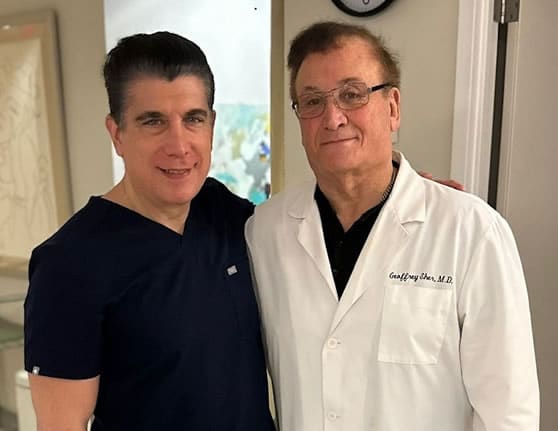
The emphasis we put on innovative, state-of-the-art technology began with our founder, Dr. Geoffrey Sher, one of the pioneers in the field of IVF, who has been influential in the births of more than 17,000 IVF babies. Dr. Sher plays an active role alongside our medical director, Dr. Drew Tortoriello. Together they have over 55 years of clinical and academic experience in the field of Reproductive Medicine.

Together, they were the first to introduce Preimplantation Genetic Testing which vastly increases the chances of IVF success and is now performed worldwide. They also pioneered the testing and treatment of Immunologic Implantation Dysfunction (IID) that frequently leads to “unexplained” infertility, repeated IVF failure, and recurrent miscarriage. We’re able to conduct a variety of other treatments and tests right on site. For example, we offer on-site sperm testing to ensure proper sperm selection techniques are used to create the healthiest possible embryos.

For those women seeking to preserve their fertility, we offer vitrification, a state-of-the-art technology that ensures their eggs will ultimately be thawed successfully.

From the moment you walk into our state-of-the-art New York fertility clinic, you’ll feel the warmth and compassion that will define your experience with us. Drew Tortoriello, MD serves as our Medical Director. He’s an outstanding fertility specialist that you’ll find to be caring, compassionate and personable.

When you receive fertility treatment with us, your doctor will participate with hands-on management of your case throughout your treatment. We’ve gained a reputation of being the place to turn to when all other treatment options have failed, and patients are searching for hope and fresh alternatives.

TL;DR:

  • Our doctors are among the best in the world, with over 55 years of combined experience
  • Together, they pioneered several tests and treatments that can help where other treatments have failed
  • We do many tests right here at the clinic, which means faster results and ensures proper techniques are used
  • Your doctor will be with you at every step of your treatment
  • Everyone here will get to know you during your treatment so you won’t just feel like a number
  • We’re known for being the clinic to go to when all other treatments have failed

Author