Your Trusted Fertility Clinic In New York, NY

Your Journey. Your Family.

At Sher Fertility Solutions, we understand that each patient is unique. Everything we do is customized to you and your specific needs.

Group photo of the Sher Fertility Solutions clinic team

Where Are You On Your Fertility Journey?

I´m just starting out

I need more information

Ready to get started

Book a consultation

I need help

Ask a question

Su clínica de fertilidad de confianza en New York, NY

Tu viaje. Tu familia.

En Sher Fertility Solutions, entendemos que cada paciente es único. Todo lo que hacemos está personalizado para usted y sus necesidades específicas.

Group photo of the Sher Fertility Solutions clinic team

Nuestros Servicios

Fertilización In Vitro (IVF)

La Fertilización In Vitro (IVF) es uno de los tratamientos de fertilidad más efectivos. Este proceso implica la combinación de óvulos y espermatozoides en un laboratorio para crear embriones, que luego se transfieren al útero. Más información sobre IVF

Inseminación Intrauterina (IUI)

La Inseminación Intrauterina (IUI) es un procedimiento menos invasivo en el que se colocan espermatozoides directamente en el útero durante la ovulación. Es una opción popular para parejas con problemas leves de fertilidad. Más información sobre IUI

Congelación de Óvulos

La Congelación de Óvulos permite a las mujeres preservar su fertilidad para el futuro. Este procedimiento es ideal para aquellas que desean retrasar la maternidad por razones personales o médicas. Más información sobre Congelación de Óvulos

Reserve una consulta

Si está interesado en tener una consulta sobre tratamiento de fertilidad con uno de nuestros médicos, por favor complete este formulario

Su clínica de fertilidad de confianza en New York, NY

Five Start Rating

Your Trusted Fertility Clinic in New York, NY

Five Start Rating

Your Trusted Fertility Clinic in New York, NY

The Best of Dr. Sher on The Egg Whisperer Show

Our Services

Infertility diagnosis/treatment

The causes of infertility are multiple and are often difficult to define but may include anatomical conditions involving tubal patency and/or function as well as diseases of the testicles and/or or sperm ducts, dysfunctional levels of certain hormones in both men and women, and ovulation difficulties in women.

Recurrent miscarriage diagnosis/treatment

The time has come to embrace the reality that the term “unexplained” is rarely applicable to 1) infertility of unknown cause, 2) repeated IVF failure, and 3) recurrent pregnancy loss (RPL). More often than not, rather than being “unexplained,” the condition is simply ignored and as such remains “undiagnosed.” All that is needed is to investigate and treat the issue appropriately in order to solve the problem.

Egg freezing for future fertility

There are many reasons why patients may need to preserve their fertility. For some, it may be a focus on education and career delays and for others it may be due to an illness. Although the decline in reproductive potential that occurs with age cannot be reversed, freezing your eggs at a younger age may allow the eggs to be preserved until you are ready to conceive. While there are no guarantees, using cryopreserved eggs may improve your chances for pregnancy in the future.

Testimonials

Ask Our Doctors

Dear Patients,
I created this forum to welcome any questions you have on the topic of infertility, IVF, conception, testing, evaluation, or any related topics. I do my best to answer all questions in less than 24 hours. I know your question is important and, in many cases, I will answer within just a few hours. Thank you for taking the time to trust me with your concern.

– Geoffrey Sher, MD

Name: Fay K

Hi,

I am preparing for a transfer next week. My doctor says lining is good. I am wondering what you think of bed rest after a transfer? Also, I am stressed about this working and have a busy work and home life, so I can concerned my anxiety can affect successful implantation. What do you think?

age 27, IVF for genetics.(I had 2 kids naturally easily before this)
Thanks!

Answer:

Good luck!


In my opinion there is no need for extended bed-rest post-transfer.


Unquestionably, the IVF doctor’s expertise in performing embryo transfer ranks as one of the most important factors that will determine IVF outcome. It takes confidence, dexterity, skill, gentility and above all, experience to do a good transfer. This having been said, of all the procedures in IVF this is the most difficult to teach. It is a true “art” and there is little doubt that many women will fail to conceive following IVF simply because their doctor could not perform this procedure optimally.


Good quality embryos are those whose cells (blastomeres) continue to divide at a regular and predictable rate, such that  within 72 hours of fertilization they contain 6-9 cells and within 5-6 days, they will have developed into  expanded blastocysts.. Such embryos are the ones that are most likely to be “competent” (i.e., able to propagate a pregnancy upon being transferred to a receptive uterus). Those that do not, are the ones least likely to be “incompetent”. In fact embryos that fail to develop into expanded blastocysts within 5-6 days of being fertilized, are almost invariably, chromosomally abnormal (aneuploid) and are unworthy of transfer .


The addition of genetic embryo testing by methods such as next generation gene sequencing -NGS (which assesses all its chromosomes), at least doubles the ability to select truly “competent” embryos for transfer. This significantly increases the baby rate per embryo transferred, markedly reduces the likelihood of miscarriage, and minimizing the occurrence of chromosomal birth defects such as Down’s syndrome. Shortly before being transferred, the embryos are put together in a single laboratory dish containing growth medium. The laboratory staff informs the clinic coordinator that the embryos are ready for transfer, and the coordinator prepares the patient and informs the physician that a transfer is imminent.


Ultrasound Guided Embryo Transfer… A Must!

Today all embryo transfers should in my opinion be performed under direct ultrasound guidance to ensure proper placement in the uterine cavity. All other factors being equal , such practice, properly conducted, will significantly enhanced embryo implantation and pregnancy rates.


The full bladder:

We prefer to perform all embryo transfers when the woman has a full bladder. This facilitates the visualization of the uterus by abdominal ultrasound and causes reflex nervous suppression of uterine contractility. . The patient is allowed to empty her bladder 10 minutes following the embryo transfer.


Relaxation:

It is important that the woman be as relaxed as possible during the embryo transfer because many of the hormones that are released during times of stress, such as adrenalin, can cause the uterus to contract. Accordingly we offer our patients, an oral tranquilizer (usually 5mg of oral diazepam or Valium) about a half hour prior to the embryo transfer, to relax the woman and reduce apprehension. Some IVF programs believe that imagery helps the woman relax and feel positive about the process and in the process reduce the stress level. In such a program a counselor and/or clinical coordinator may help the woman focus on visual imagery for a few minutes immediately prior to embryo transfer so as to enhance her relaxation.


How Many Embryos are Transferred?
There is an overriding need to minimize the occurrence of multiple gestations, especially high order multiples (triplets or greater). This is because of the risk of prematurity-related complications increase proportionate to the number of babies in the uterus. As a rule of thumb however, I transfer only one (1) or two (2) blastocysts at a time.

There are several confounding considerations in determining how many embryos to transfer at a time:

  1. The older the woman who produces the eggs, the greater the likelihood that upon being fertilized, the resulting embryo(s) would be “incompetent:” As an example; in the case of a woman of 33 years each morphologically good looking embryo (those with a “ high grade”) would have about a 20-30% chance of propagating a normal pregnancy while for a woman in her mid-forties, the comparable rate would be no greater than 5-10%.
  2. Another issue relates to the perceived “microscopic quality” of the embryo(s) being transferred. When a decision on how many embryos to transfer is based upon the microscopic appearance of such embryos than their microscopic “grade” should be taken into consideration.
  3. The stage of development that the embryos have reached by the time of the ET must also be taken into account in deciding how many to transfer. The reason for this is that expanded , day 5-6) blastocysts are far more likely to propagate pregnancies than are cleaved (day 2-3) embryos. Accordingly, fewer blastocysts need be transferred at a time.
  4. Genetic competency of the embryos: Since an embryo’s “competence” is far more likely in cases where it tests NGS- normal (all its chromosomes are present and intact). In such cases the transfer of only one such embryo is likely to produce a baby about 50% of the time, (regardless of the age of the egg-provider). It is thus is completely feasible to restrict the number of such embryos that are transferred to one and sometimes two.


The ET Process:

In those programs that rely relaxation therapy, as soon as the woman is sufficiently relaxed a counselor or nurse will initiate the coaching exercises during the procedure. In some cases, a specialist will administer acupuncture.   When the woman is in the proper position, and her bladder is adequately filled, the physician first inserts a speculum into the vagina to expose the cervix and then may clean the cervix with a sterile salt solution to remove any mucus or other secretions.  An abdominal ultrasound transducer is placed suprapubically on the lower abdomen to allow clear visualization of the uterus is clearly visualized. The physician then informs the embryology laboratory and awaits the arrival of the transfer catheter loaded with the embryo(s). Upon delivery of the loaded catheter to the physician performing the ET, he/she gently guides the catheter through the woman’s cervix into the uterine cavity. Once ultrasound examination confirms that the catheter is in place, the embryologist carefully injects the embryos into the uterus, and the physician slowly withdraws the catheter. The catheter is immediately returned to the laboratory where it is examined under the microscope to make sure that all the embryos have been released. Any residual embryos would be re-incubated, and the transfer process would be repeated to deliver the remaining embryos.


ET  performed under anesthesia/conscious sedation:

In cases where ET requires a lot of manipulation or when the woman is emotionally incapable of dealing with the process, I would opt for her being put under conscious sedation (using Fentanyl or Propafol) and then performing the same procedure as described above. This approach does not in any way compromise success


Transmyometrial ET:

 In cases where for anatomical reasons, it is impossible to traverse the cervical canal, the patient can undergo a transmyometrial ET. Here, with the woman under anesthesia/conscious sedation, a special (Kato Asch) needle  is passed through the uterine wall (myometrium) into the uterine cavity. Under transabdominal ultrasound guidance, a  thin catheter containing the embryo(s) is threaded through the lumen of the catheter into the uterine cavity and the embryo’s are discharged.. Performing transmyometrial ET is takers quite a bit of skill to perform. It is in my opinion, a “last resort approach” but when required it can be very effective an successful. I have conducted at least 2 dozen such procedures over the years and have had considerable success.


Post-Embryo transfer instructions:

I usually require that my patients remain recumbent for about 30mn after the ET. Thereupon they return to their home/hotel. I do not require absolute bedrest. However, I suggest that they limit their physical activities for about 12 hours and try to avoid undue stress. I also advise them to restrict caffeine and alcohol intake and to avoid sexual penetration until ultrasound confirmation of pregnancy at 6-7 weeks or until pregnancy is discounted.


______________________________________________________

ADDENDUM: PLEASE READ!!

INTRODUCING SHER FERTILITY SOLUTIONS (SFS)

Founded in April 2019, Sher Fertility Solutions (SFS) offers online (Skype/FaceTime) consultations to patients from > 40 different countries. All consultations are followed by a detailed written report presenting my personal recommendations for treatment of what often constitute complex Reproductive Issues.


If you wish to schedule an online consultation with me, please contact my assistant (Patti Converse) by phone (800-780-7437/702-533-2691), email (concierge@SherIVF.com) or,  enroll online on then home-page of my website (www.SherIVF.com)


PLEASE SPREAD THE WORD ABOUT SFS!


Geoff Sher

________________________________________________________________________

ADDITIONAL INFORMATION:

I am attaching online links to two E-books which I recently  co-authored with  my partner at SFS-NY  (Drew Tortoriello MD)……. for your reading pleasure:

1.From In Vitro Fertilization to Family: A Journey with Sher Fertility Solutions (SFS) “

http://sherfertilitysolutions.com/sher-fertility-solutions-ebook.pdf

  1. “Recurrent Pregnancy Loss and Unexplained IVF Failure: The Immunologic Link

https://drive.google.com/file/d/1iYKz-EkAjMqwMa1ZcufIloRdxnAfDH8L/view

………………………………………………………………..


Latest Videos

Blog

No Results Found

The page you requested could not be found. Try refining your search, or use the navigation above to locate the post.

Our Team
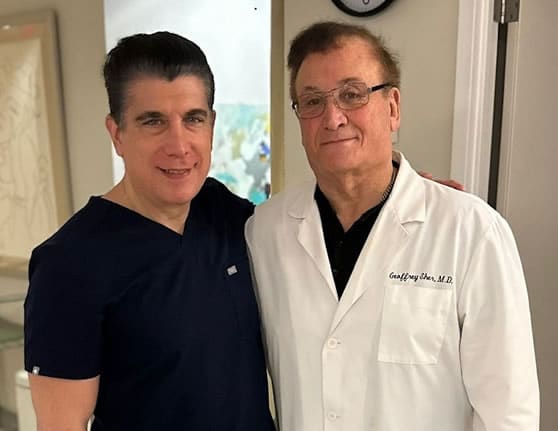
The emphasis we put on innovative, state-of-the-art technology began with our founder, Dr. Geoffrey Sher, one of the pioneers in the field of IVF, who has been influential in the births of more than 17,000 IVF babies. Dr. Sher plays an active role alongside our medical director, Dr. Drew Tortoriello. Together they have over 55 years of clinical and academic experience in the field of Reproductive Medicine.

Together, they were the first to introduce Preimplantation Genetic Testing which vastly increases the chances of IVF success and is now performed worldwide. They also pioneered the testing and treatment of Immunologic Implantation Dysfunction (IID) that frequently leads to “unexplained” infertility, repeated IVF failure, and recurrent miscarriage. We’re able to conduct a variety of other treatments and tests right on site. For example, we offer on-site sperm testing to ensure proper sperm selection techniques are used to create the healthiest possible embryos.

For those women seeking to preserve their fertility, we offer vitrification, a state-of-the-art technology that ensures their eggs will ultimately be thawed successfully.

From the moment you walk into our state-of-the-art New York fertility clinic, you’ll feel the warmth and compassion that will define your experience with us. Drew Tortoriello, MD serves as our Medical Director. He’s an outstanding fertility specialist that you’ll find to be caring, compassionate and personable.

When you receive fertility treatment with us, your doctor will participate with hands-on management of your case throughout your treatment. We’ve gained a reputation of being the place to turn to when all other treatment options have failed, and patients are searching for hope and fresh alternatives.

TL;DR:

  • Our doctors are among the best in the world, with over 55 years of combined experience
  • Together, they pioneered several tests and treatments that can help where other treatments have failed
  • We do many tests right here at the clinic, which means faster results and ensures proper techniques are used
  • Your doctor will be with you at every step of your treatment
  • Everyone here will get to know you during your treatment so you won’t just feel like a number
  • We’re known for being the clinic to go to when all other treatments have failed

Author