Your Trusted Fertility Clinic In New York, NY

Your Journey. Your Family.

At Sher Fertility Solutions, we understand that each patient is unique. Everything we do is customized to you and your specific needs.

Group photo of the Sher Fertility Solutions clinic team

Where Are You On Your Fertility Journey?

I´m just starting out

I need more information

Ready to get started

Book a consultation

I need help

Ask a question

Su clínica de fertilidad de confianza en New York, NY

Tu viaje. Tu familia.

En Sher Fertility Solutions, entendemos que cada paciente es único. Todo lo que hacemos está personalizado para usted y sus necesidades específicas.

Group photo of the Sher Fertility Solutions clinic team

Nuestros Servicios

Fertilización In Vitro (IVF)

La Fertilización In Vitro (IVF) es uno de los tratamientos de fertilidad más efectivos. Este proceso implica la combinación de óvulos y espermatozoides en un laboratorio para crear embriones, que luego se transfieren al útero. Más información sobre IVF

Inseminación Intrauterina (IUI)

La Inseminación Intrauterina (IUI) es un procedimiento menos invasivo en el que se colocan espermatozoides directamente en el útero durante la ovulación. Es una opción popular para parejas con problemas leves de fertilidad. Más información sobre IUI

Congelación de Óvulos

La Congelación de Óvulos permite a las mujeres preservar su fertilidad para el futuro. Este procedimiento es ideal para aquellas que desean retrasar la maternidad por razones personales o médicas. Más información sobre Congelación de Óvulos

Reserve una consulta

Si está interesado en tener una consulta sobre tratamiento de fertilidad con uno de nuestros médicos, por favor complete este formulario

Su clínica de fertilidad de confianza en New York, NY

Five Start Rating

Your Trusted Fertility Clinic in New York, NY

Five Start Rating

Your Trusted Fertility Clinic in New York, NY

The Best of Dr. Sher on The Egg Whisperer Show

Our Services

Infertility diagnosis/treatment

The causes of infertility are multiple and are often difficult to define but may include anatomical conditions involving tubal patency and/or function as well as diseases of the testicles and/or or sperm ducts, dysfunctional levels of certain hormones in both men and women, and ovulation difficulties in women.

Recurrent miscarriage diagnosis/treatment

The time has come to embrace the reality that the term “unexplained” is rarely applicable to 1) infertility of unknown cause, 2) repeated IVF failure, and 3) recurrent pregnancy loss (RPL). More often than not, rather than being “unexplained,” the condition is simply ignored and as such remains “undiagnosed.” All that is needed is to investigate and treat the issue appropriately in order to solve the problem.

Egg freezing for future fertility

There are many reasons why patients may need to preserve their fertility. For some, it may be a focus on education and career delays and for others it may be due to an illness. Although the decline in reproductive potential that occurs with age cannot be reversed, freezing your eggs at a younger age may allow the eggs to be preserved until you are ready to conceive. While there are no guarantees, using cryopreserved eggs may improve your chances for pregnancy in the future.

Testimonials

Ask Our Doctors

Dear Patients,
I created this forum to welcome any questions you have on the topic of infertility, IVF, conception, testing, evaluation, or any related topics. I do my best to answer all questions in less than 24 hours. I know your question is important and, in many cases, I will answer within just a few hours. Thank you for taking the time to trust me with your concern.

– Geoffrey Sher, MD

Name: Iryna S

Hi Dr. Sher,
I am 42, trying for our 2nd baby. I had regular periods and ovulated well till October 2022 when My OB doctor prescribed Clomiphene x5 days. My cycles became mess after that. Periods last for 16-17 days, often very heavy with big clots on 14th-15th day. Then after 11-12 days start again. On ultrasound there was ovarian cyst ruptured, and small uterine fibroid. I didn’t take Clomid since October, but my period problem persists for 4 months already. Can this issue be caused by Clomiphene and what can I do to restore normal cycle? Thanks.

Answer:

Clomiphene (syn; Clomid , Serophene) is by far the most widely prescribed agent for the induction of human ovulation for women who do not ovulate, those with dysfunctional ovulation and women with ”unexplained” infertility. When used in young women (who have adequate ovarian reserve) with these problems the viable pregnancy rate is reported as being between 6% and 10% per cycle of treatment. Aside from conventional ovulation induction, clomiphene has been used in preparing women for intrauterine insemination and even for IVF. I personally rarely prescribe clomiphene because across the board, success rates are significantly lower than when gonadotropin therapy is used. The main reasons for clomiphene’s popularity is its low cost, simplicity of use and the low risk of dangerous complications such as severe ovarian hyperstimulation syndrome (OHSS).

Clomiphene treatment can be initiated at a dose of 50 mg (orally) daily for 5 days but it can be increased to as much as 200mg per day, starting on cycle 2, 3, 4, or 5. A spontaneous LH surge will usually follow within about 8-9 days of the last 50mg dosage. In some cases, 10,000U of hCG can be given as a trigger when there is at least one ovarian follicle of 18-20 mm in size. Routinely using the hCG trigger does tend to decrease pregnancy potential.

Clomiphene works by inducing ovulation through its “antiestrogen effect” which, by blocking estrogen receptors in an area of the brain known as the hypothalamus, tricks the brain into “thinking” that estrogen levels are low. In response, the hypothalamus prompts the pituitary gland to release an exaggerated amount of follicle-stimulating hormone (FSH), which in turn stimulates the growth and development of ovarian follicles, ultimately resulting in a surge in the release of pituitary LH. About 38-42 hours later, ovulation occurs from one or more of the larger follicles. As the follicles grow, they release more and more estrogen into the bloodstream, thus closing the feedback circle that the hypothalamus initiated in response to the anti-estrogen properties of Clomiphene.

There are several factors that need to be considered carefully before deciding to prescribe clomiphene to any woman:

  • Clomiphene citrate therapy is less effective than gonadotropin therapy and its efficacy declines with advancing age: Many infertile couples undergoing ovulation induction believe that the success rate using clomiphene citrate is equivalent to what we see in fertile couples trying to get pregnant on their own and to what is encountered when gonadotropins (Menopur/Follistim/Gonal-F and Puregon) are used. This is not the case. The truth is that the rate of conception with clomiphene therapy is actually about 30% lower than the natural fertility rate for normally ovulating women, and about 25% lower than when gonadotropin stimulation is used for ovarian stimulation in similar patients. Moreover, the discrepancy is further magnified with advancing maternal age, where in women under 35 years, the pregnancy rate with clomiphene treatment is about 10% per cycle, about 5% between 35 and 40 years and <2% for women in their early to mid-forties.
  • Clomiphene use should ideally be confined to younger women: Ideally the use of clomiphene should in my opinion be restricted to younger women (under 35 years) who have normal “ovarian reserve” (as assessed by basal blood FSH, and antimullerian hormone (AMH) levels). These are the women who are most likely to respond by producing multiple follicles. It is necessary that at least 3 sizeable follicles (>15mm) develop on clomiphene treatment, in order to override the “anti-estrogenic” effects of this drug and so insure adequate cervical mucus production as well as the development of a receptive endometrium.
  • Clomiphene should usually not be administered for more than 3 consecutive (back-to- back) cycles: If used back-to-back for more than 3 consecutive cycles, clomiphene is not only ineffective, but actually starts to function as a “relative” contraceptive! This is often is a shocking revelation to many women. Clomiphene’s anti-estrogenic effect is not confined to the hypothalamus. Any cells that have a high concentration of estrogen receptors will also be so affected. Needless to say, the cervical glands (that produce estrogenic mucus to facilitate sperm transport and the endometrial lining (endometrium) that thickens under the effect of estrogen are also highly vulnerable to a buildup of antiestrogen effects over successive back-to back cycles of clomiphene therapy. This why with >3 consecutive back-to back clomiphene cycles cervical mucus tends to thicken and dry up and the endometrium will thin, seriously reducing the likelihood of success. These anti-estrogenic manifestations require that following 3 back-to back clomiphene cycles of stimulation there be at  least 1 resting (non-clomiphene treated) cycle, before doing a 4th cycle.
  • Clomiphene should not be used in older women or in women who have diminished ovarian reserve (DOR): With clomiphene stimulation, the  release of pituitary FSH is always accompanied by the concomitant release of Luteinizing Hormone (LH). LH causes the ovary to produce male hormone (androgens) and testosterone. The production by the ovaries of a modest amount of testosterone would not present a problem. However, an excessive production of ovarian testosterone prejudices egg development and thus ultimately compromises embryo competency. Older women and women with DOR are the most vulnerable because they tend to have overgrowth of ovarian connective tissue (stroma/theca) which is the site where androgens are produced. The concentration of androgens is always much higher at the site of production (the ovaries) than in the peripheral blood (a dilution effect). Thus in older women and those with DOR, there will be excessive ovarian androgens that can compromise egg quality and thus ultimately reduce the chance of having a baby. The older the woman and/or the more severe the DOR, the greater this adverse effect is likely to be.
  • “Trapped” ovulation (LUF-Syndrome): About 20% of clomiphene cycles are associated with “trapped” ovulation (Luteinized Unruptured Follicle (LUF) Syndrome). This means that in spite of hormone changes suggesting that ovulation has occurred, the egg remains trapped in the ovary. Obviously this is not condusive to the establishment of a successful pregnancy.
  • Endometriosis is a “relative contraindication” to the use of clomiphene: Women with endometriosis (regardless of its severity) have” toxic factors” in their pelvic peritoneal fluid. Eggs, as they pass from the ovaries to the Fallopian tubes to reach the awaiting sperm, become exposed to these “toxins” which renders the egg envelopment (zona pellucida) resistant to sperm penetration. This reduces fertilization potential by a factor of at least 3 or 4. This means that if, in the absence of endometriosis, an egg has a 15% chance of being fertilized and thereupon resulting in a baby, that same egg, in a woman with endometriosis would have no more than a 5% chance. Thus, if the overall chance of a having a baby per year of actively trying is about 12% then the chance in a woman with mild endometriosis (of the same age) would probably be no more than 3-4%. This serves to explain why normally ovulating women with endometriosis and patent Fallopian tubes do not benefit significantly from intrauterine insemination, with or without the use of fertility drugs, or from surgery to remove endometriotic lesions (since many endometriotic deposits are non-pigmented, thus invisible to the naked eye and cannot be removed surgically). Only IVF improves the chance of a baby per month of trying.  Simply put…if a normally ovulating woman who has mild to moderate endometriosis conceives following IUI, surgery, or the use of fertility drugs, it is probably in spite of (rather than due) to such treatment.
  • Women with long gaps between menstruation are often not ideal candidates for clomiphene: Women who consistently have  >45 days between their periods will not respond well to clomiphene induction of ovulation and are better off going directly to injectable gonadotropins.
  • Multiple pregnancy: The incidence of multiple pregnancies with clomiphene induction of ovulation is about 5%. This is much lower than the 25% rate encountered when gonadotropins are given to women with absent or dysfunctional ovulation.

Clomiphene therapy is often used as a first line approach to inducing ovulation in women with irregular or absent ovulation such as in women with polycystic ovarian syndrome (PCOS). Its use in my opinion is best confined to women who menstruate/ovulate irregularly (but who bleed at least every 45 days), younger women, women who do not have tubal disease or endometriosis, women under 40 years of age (preferably <35Y), and women who do not have DOR . It should also be avoided when there is co-existing male factor infertility.  If pregnancy fails to occur after 3 consecutive cycles of clomiphene therapy, then in my opinion, it is time to move on to gonadotropin therapy, combined with IUI or IVF/ICSI depending on the underlying cause of the infertility.

 Geoff Sher

ADDITIONAL INFORMATION:

I am attaching online links to two E-books which I recently  co-authored with  my partner at SFS-NY  (Drew Tortoriello MD)……. for your reading pleasure:

1.From In Vitro Fertilization to Family: A Journey with Sher Fertility Solutions (SFS) “

http://sherfertilitysolutions.com/sher-fertility-solutions-ebook.pdf

  1. “Recurrent Pregnancy Loss and Unexplained IVF Failure: The Immunologic Link

https://drive.google.com/file/d/1iYKz-EkAjMqwMa1ZcufIloRdxnAfDH8L/view


Latest Videos

Blog

No Results Found

The page you requested could not be found. Try refining your search, or use the navigation above to locate the post.

Our Team
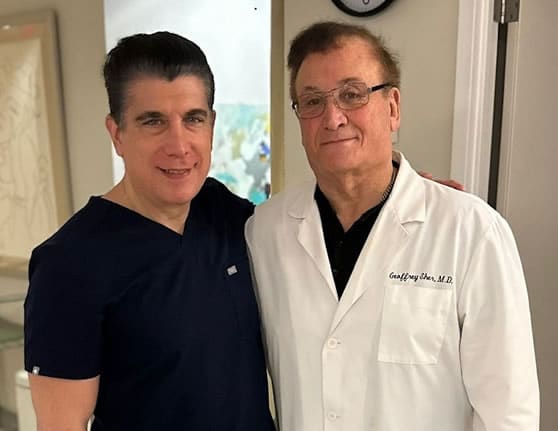
The emphasis we put on innovative, state-of-the-art technology began with our founder, Dr. Geoffrey Sher, one of the pioneers in the field of IVF, who has been influential in the births of more than 17,000 IVF babies. Dr. Sher plays an active role alongside our medical director, Dr. Drew Tortoriello. Together they have over 55 years of clinical and academic experience in the field of Reproductive Medicine.

Together, they were the first to introduce Preimplantation Genetic Testing which vastly increases the chances of IVF success and is now performed worldwide. They also pioneered the testing and treatment of Immunologic Implantation Dysfunction (IID) that frequently leads to “unexplained” infertility, repeated IVF failure, and recurrent miscarriage. We’re able to conduct a variety of other treatments and tests right on site. For example, we offer on-site sperm testing to ensure proper sperm selection techniques are used to create the healthiest possible embryos.

For those women seeking to preserve their fertility, we offer vitrification, a state-of-the-art technology that ensures their eggs will ultimately be thawed successfully.

From the moment you walk into our state-of-the-art New York fertility clinic, you’ll feel the warmth and compassion that will define your experience with us. Drew Tortoriello, MD serves as our Medical Director. He’s an outstanding fertility specialist that you’ll find to be caring, compassionate and personable.

When you receive fertility treatment with us, your doctor will participate with hands-on management of your case throughout your treatment. We’ve gained a reputation of being the place to turn to when all other treatment options have failed, and patients are searching for hope and fresh alternatives.

TL;DR:

  • Our doctors are among the best in the world, with over 55 years of combined experience
  • Together, they pioneered several tests and treatments that can help where other treatments have failed
  • We do many tests right here at the clinic, which means faster results and ensures proper techniques are used
  • Your doctor will be with you at every step of your treatment
  • Everyone here will get to know you during your treatment so you won’t just feel like a number
  • We’re known for being the clinic to go to when all other treatments have failed

Author