Your Trusted Fertility Clinic In New York, NY

Your Journey. Your Family.

At Sher Fertility Solutions, we understand that each patient is unique. Everything we do is customized to you and your specific needs.

Group photo of the Sher Fertility Solutions clinic team

Where Are You On Your Fertility Journey?

I´m just starting out

I need more information

Ready to get started

Book a consultation

I need help

Ask a question

Su clínica de fertilidad de confianza en New York, NY

Tu viaje. Tu familia.

En Sher Fertility Solutions, entendemos que cada paciente es único. Todo lo que hacemos está personalizado para usted y sus necesidades específicas.

Group photo of the Sher Fertility Solutions clinic team

Nuestros Servicios

Fertilización In Vitro (IVF)

La Fertilización In Vitro (IVF) es uno de los tratamientos de fertilidad más efectivos. Este proceso implica la combinación de óvulos y espermatozoides en un laboratorio para crear embriones, que luego se transfieren al útero. Más información sobre IVF

Inseminación Intrauterina (IUI)

La Inseminación Intrauterina (IUI) es un procedimiento menos invasivo en el que se colocan espermatozoides directamente en el útero durante la ovulación. Es una opción popular para parejas con problemas leves de fertilidad. Más información sobre IUI

Congelación de Óvulos

La Congelación de Óvulos permite a las mujeres preservar su fertilidad para el futuro. Este procedimiento es ideal para aquellas que desean retrasar la maternidad por razones personales o médicas. Más información sobre Congelación de Óvulos

Reserve una consulta

Si está interesado en tener una consulta sobre tratamiento de fertilidad con uno de nuestros médicos, por favor complete este formulario

Su clínica de fertilidad de confianza en New York, NY

Five Start Rating

Your Trusted Fertility Clinic in New York, NY

Five Start Rating

Your Trusted Fertility Clinic in New York, NY

The Best of Dr. Sher on The Egg Whisperer Show

Our Services

Infertility diagnosis/treatment

The causes of infertility are multiple and are often difficult to define but may include anatomical conditions involving tubal patency and/or function as well as diseases of the testicles and/or or sperm ducts, dysfunctional levels of certain hormones in both men and women, and ovulation difficulties in women.

Recurrent miscarriage diagnosis/treatment

The time has come to embrace the reality that the term “unexplained” is rarely applicable to 1) infertility of unknown cause, 2) repeated IVF failure, and 3) recurrent pregnancy loss (RPL). More often than not, rather than being “unexplained,” the condition is simply ignored and as such remains “undiagnosed.” All that is needed is to investigate and treat the issue appropriately in order to solve the problem.

Egg freezing for future fertility

There are many reasons why patients may need to preserve their fertility. For some, it may be a focus on education and career delays and for others it may be due to an illness. Although the decline in reproductive potential that occurs with age cannot be reversed, freezing your eggs at a younger age may allow the eggs to be preserved until you are ready to conceive. While there are no guarantees, using cryopreserved eggs may improve your chances for pregnancy in the future.

Testimonials

Ask Our Doctors

Dear Patients,
I created this forum to welcome any questions you have on the topic of infertility, IVF, conception, testing, evaluation, or any related topics. I do my best to answer all questions in less than 24 hours. I know your question is important and, in many cases, I will answer within just a few hours. Thank you for taking the time to trust me with your concern.

– Geoffrey Sher, MD

Name: Kathryn T

Hi there,

I am 36 years old with 2 children already my husband is 39.
We have been trying to conceive number 3 for close to 2 years and have experienced miscarriage & struggle conceiving.

My AMH is 6.5. Recently we have found out that my husband has antisperm antibodies at 56%.

We have been recommended IVF with ICSI however with a large cost it is a hard decision.

Would IUI still be worth trying?

Or is this a waste of money with antisperm?

Answer:

With sperm antibodies, IUI is really not a tangible option. You need IVF/ICSI.

Antisperm antibodies (ASA) are immunoglobulins that attach to sperm. They are most commonly encountered in semen, blood, cervical mucous and follicular fluid. Not all ASA bind to sperm. However, those that do so can inhibiting fertilization. Methods used to detect for the presence of SAs in blood, in the seminal plasma of the ejaculate or in the cervical mucus only measure those immunoglobulins that bind to sperm components.

ASAs are related to the stimulation of sperm antigen. Detection of ASA requires access to standard sperm antigens that are associated with fertilization. An ideal sperm antigen should be sperm specific, accessible to the antibody and play a key role in fertilization..

In about 1-4% of infertility cases the presence of antisperm antibodies (ASA) in the male or female appear to be the cause. While the presence of ASA reduces both male and fertility significantly, it does not necessarily always prevent conception altogether.  Rather, the effects are graduated; i.e., the larger the immunologic response (concentration of antibodies), the less likely it is that a pregnancy will occur and when the blood level rises above 40%, natural conception is highly unlikely to occur.

Like any other kind of antibody manufactured by the body, sperm antibodies are formed in response to antigens.  These antigens are proteins, which appear on the outer sperm membranes as the young sperm cells, develop within the male testes. In the man’s own body, his sperm are regarded as foreign invading proteins and as such would normally be targeted for attack However, under normal conditions, direct contact between the man’s blood and sperm is prevented by a cellular structure in the testes called the blood/testis barrier.  This barrier is formed by so-called, Sertoli cells, which abut very closely against each other, forming tight junctions that separate the developing sperm cells from the blood and prevent immunologic stimulation.  However, the blood/ testis barrier can be broken by physical or chemical injury or by infection.  When this barrier is breached, sperm antigens escape from their immunologically protected environment and come in direct contact with blood elements that launch an immunologic attack.


Once sperm and blood come in contact, whether in the male or female, specific antibodies are produced against them by specialized blood cells call T- and B-lymphocytes.  The three main types of sperm antibodies produced are Immunoglobulin G (IgG), Immunoglobulin A (IgA) and Immunoglobulin M (IgM).  These antibodies bind to the proteins (antigens) on the sperm head, midpiece or tail.  The antibodies formed may be of the circulatory type (in the blood serum) or secretory type (in the tissue).  This is important because high levels of antibodies in the blood serum do not invariably mean that the antibodies will find their way to the semen where they can affect the sperm.  For example, the concentration of IgG is much lower in secretions of the reproductive tract that it is in the blood.  Conversely, the local level of IgA is higher in the reproductive secretions than in the blood.  This is an important point, which we will return to later.

Once sperm antibodies have formed, they can affect sperm in several different ways.  Some antibodies will cause sperm to stick together or agglutinate.  Agglutinated sperm clump together in dense masses and thus are unable to migrate through the cervix into the uterus.  Other antibodies mark the sperm for attack by Natural killer (NK) cells of the body’s immune system (ie; opsonizing antibodies).  Some antibodies cause reactions between the sperm membrane and the cervical mucus preventing the sperm from swimming through the cervix (ie; immobilizing antibodies).  Antibodies can also block the sperm’s ability to bind to the zona pellucida of the egg, a prerequisite for fertilization (ie; blocking antibodies).  Finally, there is recent evidence that the fertilized egg shares some of the same antigens that are found on the sperm.  It is possible that sperm antibodies present in the mother can react with the early embryo, resulting in its destruction by phagocytic (ie; phagocytic antibodies) cells.


In my opinion, ASA tests are best performed on blood. There are a number of diagnostic tests available to detect the presence of sperm antibodies.  There are several methods for the diagnosis These tests are performed by flow cytometry and the ELISA (enzyme-linked immunoabsorbent assay), the Franklin-Dukes sperm agglutination assay or the Immunobead Binding Test (IBT).the  indirect immunofluorescence (IIF) assay, to name a few. My preference is the IBT.

In the male, IgA and IgG are found in the semen although there is controversy as to whether they originate locally (secreted by testicular cells) or cross over from the circulation.  Antibodies of the IgM class are not found in semen.

Like the source of some antibodies, the question of the critical levels of sperm antibodies is also hotly debated among clinicians.  There seems to be general agreement that blood levels above 30% by the IBT are associated with significant fertility problems.

ADDITIONAL INFORMATION:

I am attaching online links to two E-books which I recently  co-authored with  my partner at SFS-NY  (Drew Tortoriello MD)……. for your reading pleasure:

1.From In Vitro Fertilization to Family: A Journey with Sher Fertility Solutions (SFS) “

http://sherfertilitysolutions.com/sher-fertility-solutions-ebook.pdf

  1. “Recurrent Pregnancy Loss and Unexplained IVF Failure: The Immunologic Link

https://drive.google.com/file/d/1iYKz-EkAjMqwMa1ZcufIloRdxnAfDH8L/view


Studiers have shown that pregnancy is highly unlikely following natural intercourse or intrauterine insemination when either the woman or the man harbors significant antisperm antibodies.


Attempts have to try and remove antibodies from sperm by allowing the sperm to swim through a column of beads are by and large unsuccessful. And, while there have been isolated reports that administration of corticosteroids (eg; prednisone) will temporarily suppress antibody production pregnancy rates are poor. Besides, corticosteroid therapy carries with it the risk of significant side, some of which (although infrequent) can be serious. As an example, in the man spontaneous fractures (especially of the neck of the femur) have been reported in 2 % of cases. I do not recommend this treatment.


In Vitro Fertilization (IVF) with intracytoplasmic Sperm injection (ICSI) is the best option. Here each egg is injected with a single sperm and whether there are antibodies attached to the outer surface of the sperm becomes irrelevant.. In fact, pregnancy and birth rates are the same as in cases where IVF is performed for reasons other than male factor infertility. IVF/ICSI success rates are also .not unaffected by the concentration of antisperm antibodies.


Latest Videos

Blog

No Results Found

The page you requested could not be found. Try refining your search, or use the navigation above to locate the post.

Our Team
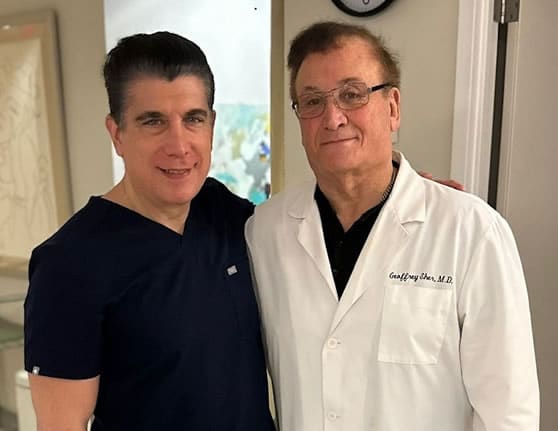
The emphasis we put on innovative, state-of-the-art technology began with our founder, Dr. Geoffrey Sher, one of the pioneers in the field of IVF, who has been influential in the births of more than 17,000 IVF babies. Dr. Sher plays an active role alongside our medical director, Dr. Drew Tortoriello. Together they have over 55 years of clinical and academic experience in the field of Reproductive Medicine.

Together, they were the first to introduce Preimplantation Genetic Testing which vastly increases the chances of IVF success and is now performed worldwide. They also pioneered the testing and treatment of Immunologic Implantation Dysfunction (IID) that frequently leads to “unexplained” infertility, repeated IVF failure, and recurrent miscarriage. We’re able to conduct a variety of other treatments and tests right on site. For example, we offer on-site sperm testing to ensure proper sperm selection techniques are used to create the healthiest possible embryos.

For those women seeking to preserve their fertility, we offer vitrification, a state-of-the-art technology that ensures their eggs will ultimately be thawed successfully.

From the moment you walk into our state-of-the-art New York fertility clinic, you’ll feel the warmth and compassion that will define your experience with us. Drew Tortoriello, MD serves as our Medical Director. He’s an outstanding fertility specialist that you’ll find to be caring, compassionate and personable.

When you receive fertility treatment with us, your doctor will participate with hands-on management of your case throughout your treatment. We’ve gained a reputation of being the place to turn to when all other treatment options have failed, and patients are searching for hope and fresh alternatives.

TL;DR:

  • Our doctors are among the best in the world, with over 55 years of combined experience
  • Together, they pioneered several tests and treatments that can help where other treatments have failed
  • We do many tests right here at the clinic, which means faster results and ensures proper techniques are used
  • Your doctor will be with you at every step of your treatment
  • Everyone here will get to know you during your treatment so you won’t just feel like a number
  • We’re known for being the clinic to go to when all other treatments have failed

Author