
Your Trusted Fertility Clinic In New York, NY
Your Journey. Your Family.
At Sher Fertility Solutions, we understand that each patient is unique. Everything we do is customized to you and your specific needs.
Where Are You On Your Fertility Journey?

I´m just starting out
I need more information

Ready to get started
Book a consultation

I need help
Ask a question
Su clínica de fertilidad de confianza en New York, NY
Tu viaje. Tu familia.
En Sher Fertility Solutions, entendemos que cada paciente es único. Todo lo que hacemos está personalizado para usted y sus necesidades específicas.
Nuestros Servicios
Fertilización In Vitro (IVF)
La Fertilización In Vitro (IVF) es uno de los tratamientos de fertilidad más efectivos. Este proceso implica la combinación de óvulos y espermatozoides en un laboratorio para crear embriones, que luego se transfieren al útero. Más información sobre IVF
Inseminación Intrauterina (IUI)
La Inseminación Intrauterina (IUI) es un procedimiento menos invasivo en el que se colocan espermatozoides directamente en el útero durante la ovulación. Es una opción popular para parejas con problemas leves de fertilidad. Más información sobre IUI
Congelación de Óvulos
La Congelación de Óvulos permite a las mujeres preservar su fertilidad para el futuro. Este procedimiento es ideal para aquellas que desean retrasar la maternidad por razones personales o médicas. Más información sobre Congelación de Óvulos
Reserve una consulta
Si está interesado en tener una consulta sobre tratamiento de fertilidad con uno de nuestros médicos, por favor complete este formulario
Su clínica de fertilidad de confianza en New York, NY





Your Trusted Fertility Clinic in New York, NY

Your Trusted Fertility Clinic in New York, NY
The Best of Dr. Sher on The Egg Whisperer Show

Testimonials

Blog


Our Team

Videos
Our Services

Infertility diagnosis/treatment
The causes of infertility are multiple and are often difficult to define but may include anatomical conditions involving tubal patency and/or function as well as diseases of the testicles and/or or sperm ducts, dysfunctional levels of certain hormones in both men and women, and ovulation difficulties in women.

Recurrent miscarriage diagnosis/treatment

Egg freezing for future fertility
There are many reasons why patients may need to preserve their fertility. For some, it may be a focus on education and career delays and for others it may be due to an illness. Although the decline in reproductive potential that occurs with age cannot be reversed, freezing your eggs at a younger age may allow the eggs to be preserved until you are ready to conceive. While there are no guarantees, using cryopreserved eggs may improve your chances for pregnancy in the future.
Testimonials
Ask Our Doctors
Dear Patients,
I created this forum to welcome any questions you have on the topic of infertility, IVF, conception, testing, evaluation, or any related topics. I do my best to answer all questions in less than 24 hours. I know your question is important and, in many cases, I will answer within just a few hours. Thank you for taking the time to trust me with your concern.
– Geoffrey Sher, MD
Hi Dr Sher, my RE has asked me to trigger with both HCG 10,000 and Decapeptyl 1 ml. I find this strange.
I understand that Dual Trigger is considered for cases where there might be risk of OHSS, but I thought a dual trigger involved a small dosage of HCG along with an Agonist.
I have symptoms of PCOS like irregular periods and high insulin resistance, but my AFC is not very high (varies from 13 – 18) and AMH is 1.2 ng/mL.
Should I be worried?
Latest Videos
Blog
No Results Found
The page you requested could not be found. Try refining your search, or use the navigation above to locate the post.
Our Team
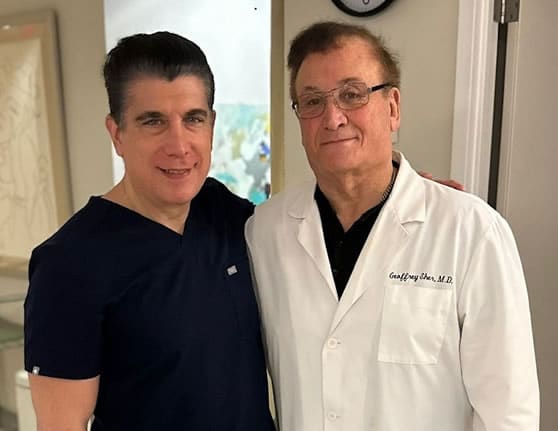
The emphasis we put on innovative, state-of-the-art technology began with our founder, Dr. Geoffrey Sher, one of the pioneers in the field of IVF, who has been influential in the births of more than 17,000 IVF babies. Dr. Sher plays an active role alongside our medical director, Dr. Drew Tortoriello. Together they have over 55 years of clinical and academic experience in the field of Reproductive Medicine.
Together, they were the first to introduce Preimplantation Genetic Testing which vastly increases the chances of IVF success and is now performed worldwide. They also pioneered the testing and treatment of Immunologic Implantation Dysfunction (IID) that frequently leads to “unexplained” infertility, repeated IVF failure, and recurrent miscarriage. We’re able to conduct a variety of other treatments and tests right on site. For example, we offer on-site sperm testing to ensure proper sperm selection techniques are used to create the healthiest possible embryos.
For those women seeking to preserve their fertility, we offer vitrification, a state-of-the-art technology that ensures their eggs will ultimately be thawed successfully.
From the moment you walk into our state-of-the-art New York fertility clinic, you’ll feel the warmth and compassion that will define your experience with us. Drew Tortoriello, MD serves as our Medical Director. He’s an outstanding fertility specialist that you’ll find to be caring, compassionate and personable.
When you receive fertility treatment with us, your doctor will participate with hands-on management of your case throughout your treatment. We’ve gained a reputation of being the place to turn to when all other treatment options have failed, and patients are searching for hope and fresh alternatives.
TL;DR:
- Our doctors are among the best in the world, with over 55 years of combined experience
- Together, they pioneered several tests and treatments that can help where other treatments have failed
- We do many tests right here at the clinic, which means faster results and ensures proper techniques are used
- Your doctor will be with you at every step of your treatment
- Everyone here will get to know you during your treatment so you won’t just feel like a number
- We’re known for being the clinic to go to when all other treatments have failed